This library is not a list of recommendations. It is a map of the ideas, works and reflections that have nourished, inspired or illuminated the building of the S.O.U.L. Montréal project. Some references are central. Others are paths of exploration. All deserve the reader's own discernment.

Conversations with God
Why it's SOUL
The central idea — that each being is in constant relationship with something greater — resonates with what happens on a dancefloor at its best. Walsh raises the question: what if the connection felt in music is not an illusion, but a real intelligence?
Summary
A three-book series in which Walsh transcribes an inner dialogue with a higher force. Without belonging to any religious tradition, the work explores consciousness, meaning, personal responsibility and the nature of the soul. Accessible, non-dogmatic, occasionally provocative.
A note of caution
Some claims lack intellectual rigor. Read as a personal exploration, not as a system of established truths.

The Four Agreements
Why it's SOUL
These four agreements describe exactly the behavior expected on an ethical dancefloor. Don't assume consent. Don't take a refusal personally. Be impeccable in your actions. These are, unknowingly, SOUL mantras before the name existed.
Summary
Drawing on Toltec wisdom from pre-colonial Mexico, Ruiz proposes four principles for living more freely: be impeccable with your word, don't take anything personally, don't make assumptions, always do your best. Short, dense, practical.
A note of caution
The 'Toltec' label is disputed by some anthropologists. The practical framework remains relevant independently of its historical authenticity.

The Prophet
Why it's SOUL
Gibran speaks of body and soul as a unity, of joy and pain as inseparable, of freedom as responsibility. These are the very tensions that the underground night explores. "Your joy is your sorrow unmasked." It's hard to find a better description of a great set.
Summary
A collection of prose poems in which Almustafa answers his friends' questions on the great human subjects: love, work, joy, pain, freedom, death. Universal, non-dogmatic, of rare depth. One of the most translated books in history.

The Power of Now
Why it's SOUL
The dancefloor experience at its best is a concrete demonstration of what Tolle describes: music dissolves the ego, the body takes over, the thinking "I" fades into the vibrational collective. This book gives an intellectual framework to what clubbers experience without always knowing how to name it.
Summary
Now a classic of consciousness literature, this book explores how the ego — that inner voice that comments and anticipates — distances us from the present moment. The central proposition: peace and fulfillment are accessible now, not in the future.
A note of caution
Some passages are repetitive, the therapeutic dimension sometimes overstated. Read as an invitation to experimentation, not as a prescription.

The Celestine Prophecy
Why it's SOUL
The idea that certain spaces foster expanded states of consciousness and that energy circulates between individuals is directly relevant. What Redfield describes in the Amazon rainforest, we find in a well-aligned room, with the right music and the right intention.
Summary
A philosophical novel recounting the discovery of a Peruvian manuscript containing nine "insights" on humanity's spiritual evolution. Blending fiction and reflection, the book explores synchronicity, energy transfers between people and the emergence of collective consciousness.
A note of caution
Thin narrative framework, insights sometimes presented without sufficient empirical grounding. Read as a thinking tool, not as a guide.

The Soul of the World
Why it's SOUL
Lenoir proposes that the soul is not separate from the body — it animates it. A fundamental vision for SOUL: we don't dance despite our body, we dance with our soul through our body. The dancefloor as a place where the soul of the world becomes collectively visible.
Summary
A philosophical essay exploring the idea that the soul — the principle of inner life and consciousness — is a reality that transcends all human cultures. Neither dogmatic nor materialist, Lenoir dialogues between Eastern mysticism, Western philosophy and cognitive sciences.
A note of caution
The argument sometimes tries to reconcile everything at the cost of philosophical rigor. A good entry point, to be deepened with other sources.
The Egregore
Why it's SOUL
The egregore describes precisely what happens when "it syncs" — when music, bodies and intentions align to create something that transcends the individuals. Every SOUL event seeks to generate a positive egregore, consciously and collectively.
Summary
A concept designating a psychic entity or force born from the gathering of several individuals sharing a common intention. Originating in esotericism, adopted in collective psychology to describe group consciousness phenomena — the emergence of a dynamic that exceeds the sum of the individuals present.
A note of caution
A term from esotericism. Equivalents exist in social psychology: behavioral synchrony, collective consciousness, group intelligence.
Technoshamanism — Spiritual Healing in the Rave Subculture
Why it's SOUL
The rave is a collective, immersive nocturnal ceremony that produces altered states of consciousness comparable to shamanic practices. The DJ is the "technoshaman" — harmonic navigator, high priest, vinyl shaman — who guides the collective psychic journey and modulates the group's emotions. This framework gives profound anthropological legitimacy to the underground experience.
Summary
Scott R. Hutson argues that raves function as spaces of collective spiritual healing — and not as mere postmodern emptiness. Repetitive music, rhythmic bass, prolonged dancing and collective synchronization induce ecstatic states comparable to shamanic rituals. Participants describe experiences of transcendence, ego dissolution and communal connection. Hutson compares this to the trance dances of the Ju/'hoansi of Botswana, and to the search for a "primordial state of human unity".
A note of caution
Don't romanticize shamanism. The analogy is a tool for understanding — not a direct comparison. The presence of substances (MDMA) in some contexts is documented in the article and should not be ignored.
Body Zones Activated by Music Style
Why it's SOUL
Provides a scientific anchor to the bodily experience of the dancefloor. It's not "just a feeling" — it's neurology. Music is a language the body understands before the mind translates it. The dancefloor is not a place of entertainment: it's a sensory laboratory.
Summary
An article documenting research on how different music styles activate specific body zones. Bass frequencies activate the lower body, high frequencies the face and hands, rhythmic music the motor system. The body map of music varies according to genre and tempo.
The Encyclopedia of Religions
Why it's SOUL
Helps understand that connection, trance, ritual, community and transcendence are universal experiences, lived in a thousand forms throughout history. SOUL doesn't reinvent the wheel. It reinvents the space.
Summary
A reference work compiling the world's religious and spiritual traditions. Exact author and edition to be confirmed. A comparative tool for understanding the universal structures of sacred human experience across cultures and eras.
Video Series on the Soul — "I AM"
Why it's SOUL
Relevance to be documented once the content is confirmed.
Summary
A series exploring the nature of the soul and the idea that each being has a deep essence that seeks to express itself through lived experience. Details, author and links to be confirmed.
Can We Understand God?
Why it's SOUL
Relevance to be documented once the content is confirmed.
Summary
An exploration of questions of spirituality and metaphysics from an accessible, non-dogmatic perspective. Author, format and link to be confirmed.
Gratitude — An Emotion That Flows Through Us
Why it's SOUL
Gratitude — towards the music, others, the space, the night — is one of the foundational postures of the conscious clubber. It transforms an event into an experience, and a shared space into an egregore of goodwill.
Summary
"Gratitude is an emotion that flows through us, like a flow of energy directed toward a person." Studies show that the most grateful people are less depressed, less stressed and more satisfied with their social relationships — gratitude acts as a buffer against depression and strengthens the sense of belonging.
BibleProject — Compassion
Why it's SOUL
The themes covered — compassion, kindness, collective peace, justice — are universal and are found in the SOUL mantras. A resource for understanding the cultural origins of humanistic values that many share without always knowing how to name or situate them historically.
Summary
A series of short animated videos explaining the great biblical themes — compassion, justice, shalom, love, freedom — in an accessible and non-proselytizing way. BibleProject offers a cultural decoding of concepts that have shaped Western civilization, independent of any religious adherence.
A note of caution
Rooted in a Judeo-Christian framework. To be used as a cultural decoding tool, not as a normative spiritual reference.
DEOS Presentation — FESTIPAC Conference
Why it's SOUL
This is the direct source. This presentation is one of the first texts to formalize the thinking behind the SOUL mantras — it documents the project's original intention before it was even called SOUL.
Summary
A conference presentation developed by Chris de la Costa for the FESTIPAC project, laying the conceptual foundations of underground ethics: the role of music, collective consciousness, responsibility of the festive space. One of the founding documents of the corpus that led to S.O.U.L. Montréal.
Grand FESTIPAC ORIGIN 2 Text
Why it's SOUL
The origin text. It documents the author's thinking on what "living well together at night" means, long before S.O.U.L. took shape. The direct philosophical soil of the entire approach.
Summary
A founding text published as part of the FESTIPAC project, laying the foundations of underground ethics philosophy. Personal reflection on the collective experience, the night, music and community — predating S.O.U.L. Montréal, but directly linked to its genesis.
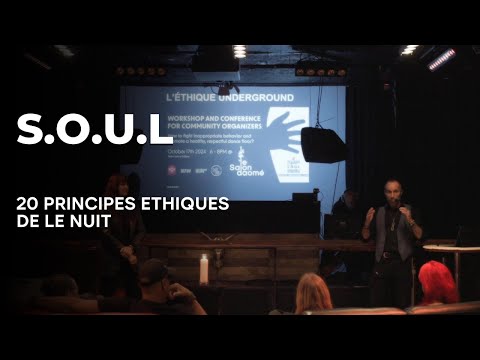
S.O.U.L. — 20 Ethical Principles of the Night
Why it's SOUL
This is the starting corpus. These 20 principles crystallize into a coherent and practical list what constitutes a successful underground night — from individual intention to collective responsibility. This document is the direct ancestor of the SOUL mantras.
Summary
A list of 20 ethical principles developed to define the spirit of an authentic underground event. Covers posture on the dancefloor, respect, consciousness, attitude toward music and the collective. Presented in video form by Chris de la Costa.
The Spirit of Underground Life
Why it's SOUL
This founding text lays the philosophical foundations of the S.O.U.L. project. This is where the idea of an underground ethics took its narrative form — even before S.O.U.L. existed as an organization. Five chapters, one vision. Available in writing, audio and video.
Summary
A fundamental text by Chris de la Costa, developed in five chapters. Explores what it means to live the underground night with consciousness, integrity and community. Published in writing on the Les Paroles de Chris blog — also available in audio reading on YouTube (5 chapters) and as an album on SoundCloud.
S.O.U.L. MANIFEST — The Concept of Good Resonance
Why it's SOUL
This founding text introduces the tuning fork as a symbol of ethical action: the human being who "rings true" helps restore collective harmony. The lamp represents spiritual intention, the tuning fork represents concrete action. This is the philosophical manifesto of the project's beginnings.
Summary
A philosophical text presenting the S.O.U.L. movement through the concept of good resonance. Each individual is compared to a tuning fork: when they vibrate truly, they contribute to the harmony of the group. Available in text version and in audio reading by Costa.
Les Paroles de Chris — Reflection & Spirituality
Why it's SOUL
This blog is Costa's philosophical journal. Each text documents the thinking behind the SOUL project: the night, consciousness, the collective, non-dogmatic spirituality. A living archive of the founding thought.
Summary
The "Reflection and Spirituality" category of the Les Paroles de Chris blog. Personal texts on the underground night experience, the soul and meaning. Putting into words what is experienced on the dancefloor — and beyond. Category description: "Making experience conscious".
HNM — Interview with Rick Pier O'Neil
Why it's SOUL
Rick Pier O'Neil — a figure in the Montréal and international house scene — shares his vision of music and underground culture. An interview that illustrates how an artist can be an ambassador for values, not just a performer.
Summary
An interview in which Rick Pier O'Neil talks about his artistic journey, his vision of the underground scene and the relationship between a DJ and his audience. An insider's perspective on what gives music its meaning and depth.