Protection & Consent

The Signal for Help adapted for nightlife

A silent, one-handed gesture that can change everything. Created by the Canadian Women's Foundation. Adapted by S.O.U.L. Montréal for the underground scene.

When the music is too loud to speak. When the light is too dim to see. When your body won't respond. One gesture remains.

If you see this gesture, intervene.

If you feel in danger and can't defend yourself, do it!

Why this signal exists

In April 2020, the Canadian Women's Foundation created the Signal for Help — a silent, discreet gesture allowing anyone experiencing violence or distress to ask for help without saying a word.

Since then, this signal has been shared in over 50 countries, translated into 20 languages, and has literally saved lives — including a teenager in North Carolina who used the gesture through a car window to alert a passerby.

S.O.U.L. Montréal believes this signal belongs on the dance floor. Underground parties are spaces of freedom — but that freedom must come with collective vigilance. When words fail, the gesture takes over.

The gesture — three steps

One continuous movement, one hand, one second.
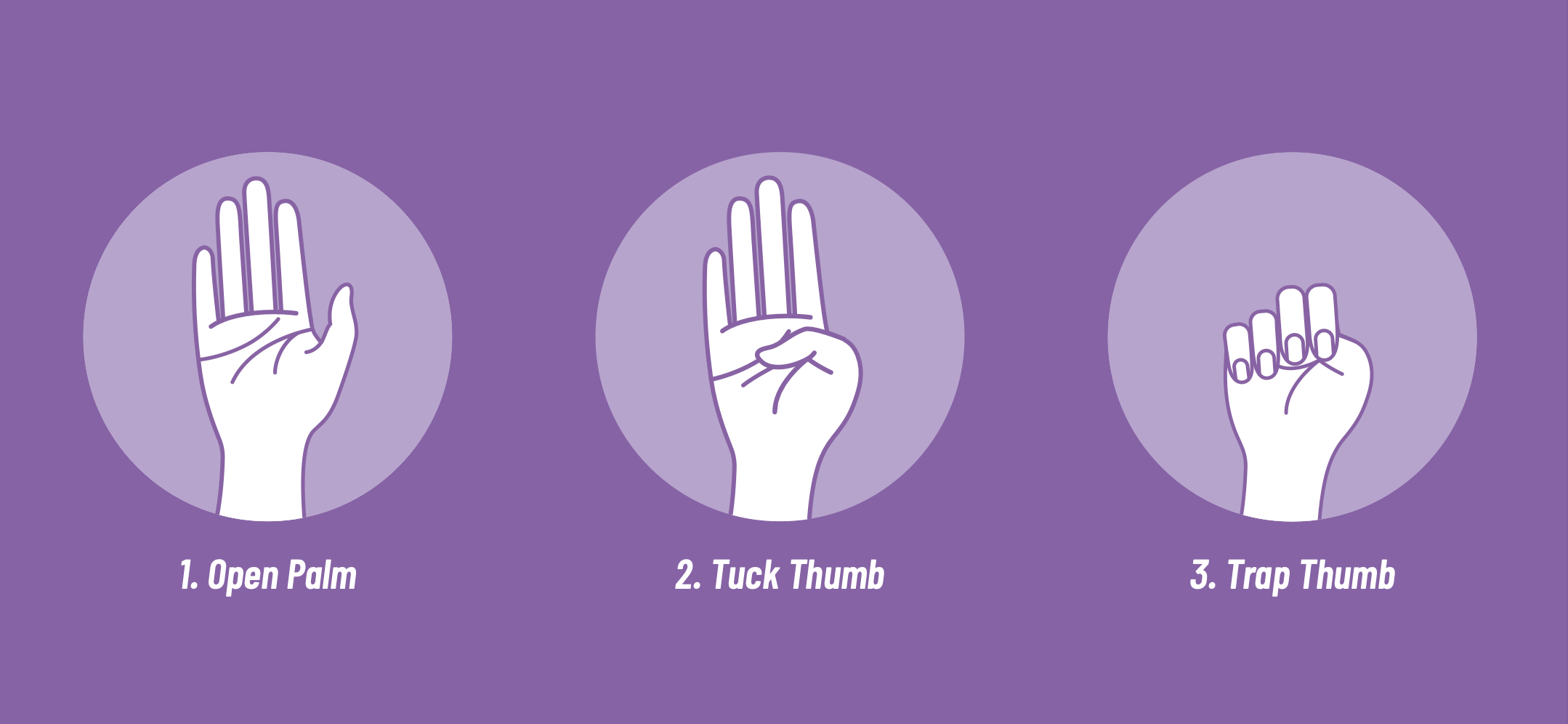
Signal for Help — 1. Open palm, 2. Tuck thumb, 3. Trap thumb
1
Open palm
Raise your hand, palm facing the person you want to alert. All five fingers spread.
2
Tuck your thumb
Fold your thumb inward across your palm. The thumb is "trapped" — that's the metaphor.
3
Close your fingers
Trap your thumb under your four fingers. The fist closes. The message is sent.

This signal means: "Check in with me safely." Not necessarily: "Call the police."
Adapted for nightlife

The underground scene presents unique challenges. The Signal for Help is designed to work exactly where other means fail.

When the music drowns everything
Impossible to scream, speak, or call for help. The gesture needs no sound. It only needs someone's eyes.
When light is scarce
Even in near-darkness, a hand movement catches attention. The human brain detects motion before detail — one gesture is enough.
When the body won't respond
Under the effect of substances or fear, speech and thought can shut down. This signal only requires one hand and a memorized reflex.
When the aggressor is right there
The gesture is discreet — it can be made at hip level, near your face, or behind a glass. No need to attract the wrong person's attention.

If you see this gesture:

What you do in the next few seconds can change everything.

1

Approach safely

Don't make it obvious that you saw the signal. Walk up naturally, like you know them. "Hey, long time no see! Come, let's get some air."

2

Create a diversion

If the person is with their aggressor, find an excuse: "I'm looking for someone, can you help?" or "We need you over there." The goal: separate the person from the threat.

3

Listen and validate

Once safe, ask simple questions (yes/no if speech is difficult). Don't judge. Don't minimize. Listen.

4

Connect with resources

Direct the person to event security, a trusted friend, or help services. Stay with them until they are safe.

!

Never confront the aggressor directly

Your priority is the victim's safety, not confrontation. If the situation is dangerous, call 911 immediately.

In case of immediate danger
If you or someone around you is in immediate danger, never hesitate.
911

Resources

Domestic Violence Hotline
24/7, confidential, free
1-800-363-9010
Sexual Assault Crisis Line
24/7, confidential
1-888-933-9007
Women's Shelters
Find a refuge
hebergementfemmes.ca
Origin
Canadian Women's Foundation

The Signal for Help was created by the Canadian Women's Foundation in April 2020. Freely distributed, it has been adopted by over 200 organizations in more than 50 countries.

S.O.U.L. Montréal adapts this signal to the underground nightlife context with the intention of protecting every vulnerable person on our dance floors.

QR Code — Signal for Help Mini-Course
Official mini-course — free

Learn to recognize the signal, respond safely, and share it in your community.

Take the course →
S.O.U.L. Montréal

Learn the gesture. Share it. Protect each other.

If just one person in the room knows this signal, it can be enough. Imagine if everyone did.

Mantra #2 — No Means No → Join the Consultation